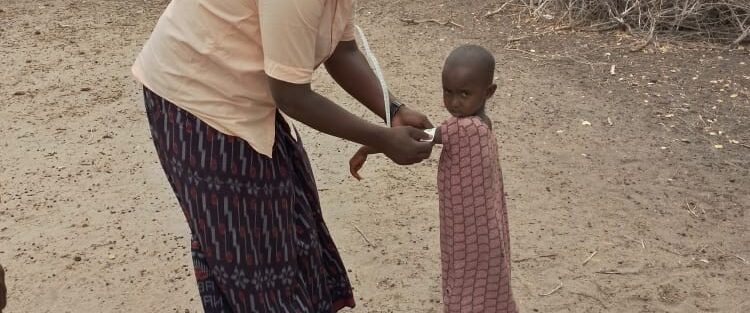
Under the shade of scattered acacia trees in Dagahaley, a man bends carefully over a youg toddler as her parents look on. His hands are steady, his expression intent, as he wraps a colour-banded MUAC tape around the child’s tiny arm. The child, barefoot and wrapped in a faded pink dress, stares back at the camera with solemn eyes—too young to understand the quiet urgency of the moment.
This is Hussein, a 24-year-old Community Health Volunteer (CHV). The scene is a familiar one in northern Kenya, where measuring children’s arms is often the first step in detecting not only malnutrition, but also other silent killers like tuberculosis (TB). In places like Dadaab, where undernutrition and TB reinforce each other, the tape becomes more than a strip of plastic—it becomes an early-warning signal.
Malnourished children and adults are far more vulnerable to TB. When Hussein’s tape shows a child is underweight, it triggers more than just a nutrition referral; it also raises the need to check for TB contacts in the family. Often, a malnourished child is living in the same crowded shelter as an adult with chronic cough, fatigue, or fever—symptoms that may be ignored or hidden due to stigma. By using the MUAC tape as an entry point, Hussein can start a conversation, gently probe for TB symptoms, and link households to health facilities before the disease spreads further.
For Hussein, this work is personal. His pastoralist family lost their livestock to repeated droughts. Like many young men in Dadaab, he juggles odd jobs to support siblings. Yet he carries his tape measure as both a tool and a responsibility—a way to spot vulnerability before it becomes tragedy.
The challenges are immense. His stipend is irregular. He walks long distances under punishing heat, sometimes through insecure areas. Families often expect him to give medicine or know if any outreach is coming and may bring TB products and service closer to them. Many CHVs in his shoes have given up but Hussein has stayed on
Earlier this year, a three-day training organized for TB warriors – like Hussein – from other camps gave him a renewed strength to soldier on for his community armed with the latest knowledge around TB in the camps. Facilitated by local speaking experts in Somali languages, the sessions used role-plays and real-life examples to sharpen his skills in TB case detection, stigma reduction, and patient follow-up. IEC flip charts with Somali proverbs and familiar images became his new favourite teaching tools. The programme supported with a meal and transport allowance to hire a boda boda for the days to reach distant mobile homes, while airtime bundles helped him call patients and families for follow-up.
The change was immediate. His referrals of presumptive TB cases multiplied. In a single campaign, Hussein identified 17 people with TB—most from households where undernourished children were his first entry point. By linking these patients to facilities and ensuring they adhered to treatment, Hussein helped break the chain of transmission that silently fuels TB in crowded camps. Recognition from health workers gave him new confidence.
“The community now sees me not just as a volunteer but as someone they can trust,
Hussein Abdi, CHV Dadaab refugee camps
Hussein’s story is about more than a tape measure. It is about the fragile balance of life in northern Kenya, where drought, poverty, and displacement collide, and where TB thrives in the shadows. It is also about resilience—how CHVs bridge cultural barriers, clan dynamics, and gender norms to ensure no case is missed.
WOHED with funding from STOP TB Partnership and in partnership with refugee actors and the Garissa County Department of Health, has supported CHVs like Hussein to create an exponential impact through evidence-based community engagement. A stipend, a phone card, a culturally relevant IEC flip chart—these are not luxuries. They are the very tools that allow CHVs to transform a simple MUAC tape into a gateway for TB contact tracing, early detection, and sustained treatment.
In Hussein’s hands, the tape measure is more than a strip of plastic. It is a frontline weapon in the fight against TB, a symbol of trust, and a reminder that with the right support, no child, no family, and no community must be left behind.